What the company does (Explained for a 10th Standard Student)
A solo entrepreneur named Marc Lou, does not run one single traditional company; instead, he acts like an independent software inventor who has built about 35 different mini-startups. To explain this simply: he spends his time coding small applications (apps) to solve specific problems and sees which ones people are willing to pay for.
For example, he created two specific apps mentioned in the sources:
- A Mac computer app that uses your webcam to watch your posture; if you slouch “like a shrimp,” the app tells you to sit up straight.
- An app called “Trustm,” which acts like a scoreboard to verify how much money people actually make online, helping users tell the difference between scammers and people telling the truth.
0-1000 User Framework and Marketing Strategy
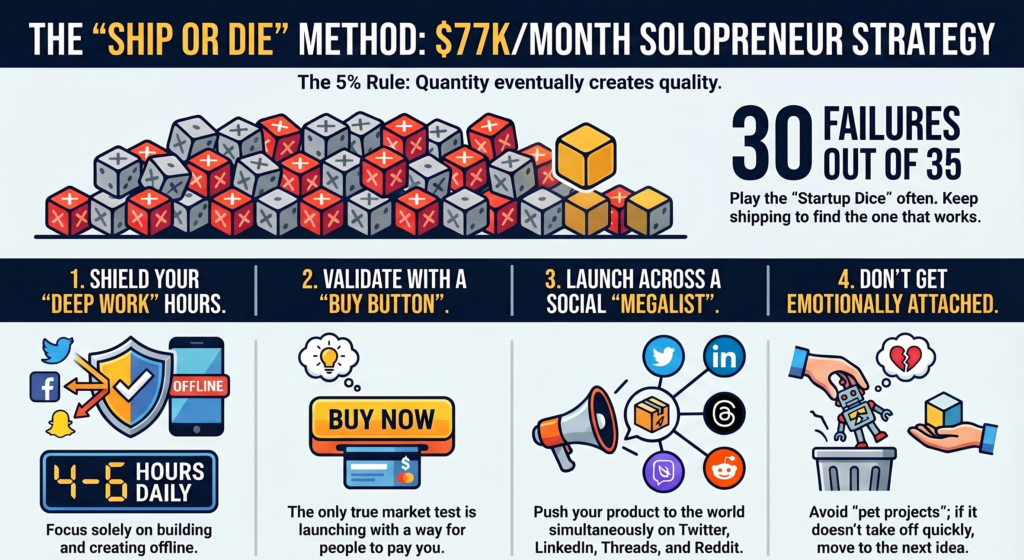
- Launch Platforms: To get his first customers, he launches his apps by posting announcements on social media platforms. Specifically, he mentions going live with a Tweet (Twitter) and sharing his work on LinkedIn, Threads, and Reddit.
- Marketing Strategy: His ongoing marketing strategy revolves around publicly sharing his journey. Every time he builds and releases (“ships”) a new idea, he learns more and shares that process online, which helps him grow an audience of people who naturally discover his work.
- Validation: A core part of his strategy is that the only way to truly test an idea is to launch it with a “buy button” so he can see if users will actually pay for it.
Tech Stack Used to Build and Pricing
The sources only briefly mention the technology he uses to build his apps:
- He uses a “basic code editor” to write his programs.
- He uses Electron to build applications for Mac OS.
- He uses ChatGPT (“Chat GBT”) directly alongside his code editor to have an AI help him write new features and speed up his coding.
Explain the ‘rolling the dice’ philosophy for shipping 35 startups.
The “rolling the dice” philosophy is based on the reality that most new business ideas will fail, meaning success comes from volume rather than over-investing in a single concept. Out of the 35 startups the entrepreneur shipped, about 30 of them were completely unsuccessful, making barely any money and gaining almost no users, which equates to a hit rate of only about 5%.
Because of this low success rate, if you only “roll the dice” once by building and sticking to a single startup, it is highly unlikely that anything life-changing will happen. However, if you continuously keep rolling the dice by launching new projects, eventually one of those attempts will work out, resulting in happy users and enough income to leave a traditional job.
This philosophy directly contrasts with a common mistake many founders make: spending six months building one “brilliant idea” and becoming so emotionally attached to it as a pet project that they waste years waiting for it to take off. Instead of getting stuck on a slow-growing project, it is much more effective to keep rolling the dice and ship a new idea, as a fresh project might take off 100 times faster than the previous one.
Additionally, this constant cycle of launching has compounding benefits. Every time you roll the dice and ship something new, you learn more and have new experiences to share online, which helps you continuously grow an audience of people who discover your work. Ultimately, playing this continuous game of launching is the true recipe for finding an idea that works.

Hi Friends, This is Swapnil; I love reading and sharing knowledge. Currently working as a content writer at startupsunion.com. You all can hang out with me here.