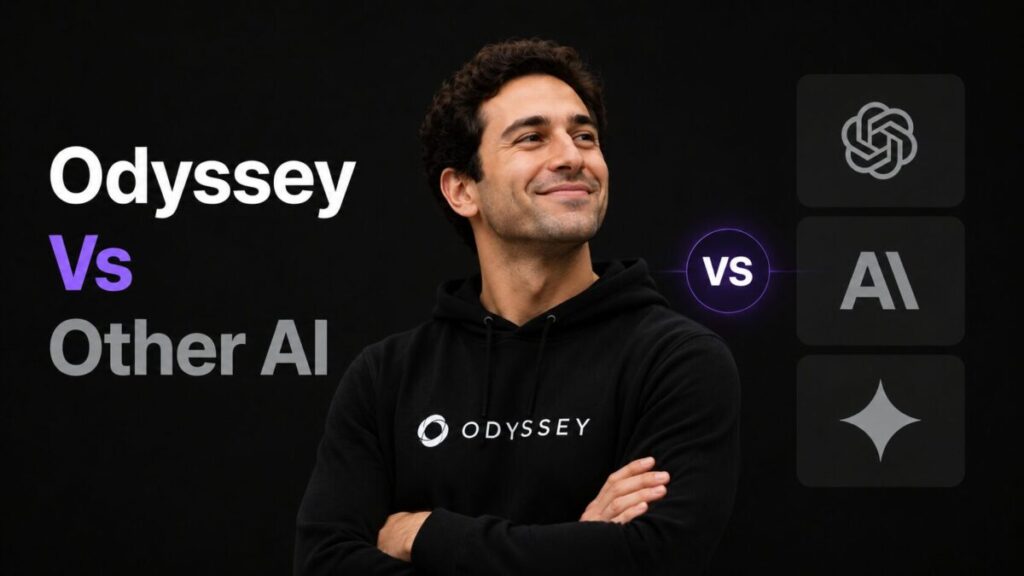
The AI space has been loud. Really loud. ChatGPT, Runway, Gemini, Claude, Midjourney. Every few months, something new shows up wearing the same costume with a different name tag. Most of them are doing one of two things: generating text or generating video clips. That is it.
Odyssey AI is not doing either of those things. Not primarily.
Founded in 2023 by Oliver Cameron and Jeff Hawke, two people who spent years building self-driving cars at Voyage, Cruise, and Wayve, Odyssey AI is building what they call world models. Causal, multimodal systems that simulate the physical world with real physics. The company just closed a $310 million Series B at a $1.45 billion valuation. Amazon, AMD Ventures, GV, EQT, and In-Q-Tel are in the round. Jeff Dean, Garry Tan, Guillermo Rauch, and Kyle Vogt from Cruise are angel investors.
So the real question is not whether Odyssey AI raised a lot of money. It did. The question is how Odyssey AI actually stacks up against other AI tools people are using right now.
What Is Odyssey AI and How Does It Work?
Here is the honest answer most articles skip over: Odyssey AI is not for everyone yet. And that is not a criticism. That is just where the technology sits in June 2026.
What it actually does is build general-purpose world models. Causal, multimodal systems that learn to predict and interact with the world over long time horizons. In plain terms, instead of generating a 20-second video clip you watch once and move on, Odyssey builds interactive environments you can physically move through. The model predicts what happens next, frame by frame, in real time, every 40 milliseconds. A continuous stream. Not a bounded clip.
The data collection method is interesting. Odyssey sends people into the field with cameras strapped to their backs, capturing pedestrian-level environmental data. Think of it as Google Earth, but instead of cars driving around, it is people walking around, so the model learns the world at ground level. That data trains the model to understand spatial relationships, object behavior, physics, and cause-and-effect in ways that language models were simply never designed to do.
The latest model is Odyssey-2 Max. Before it, Starchild-1 brought multimodal capabilities into world modeling, generating interactive video with synchronized audio that responds to speech, text, and user actions in real time. Then came Agora-1, a multi-agent world model. Multiple humans and AI agents sharing and interacting inside the same generated environment simultaneously. Their demo was a real-time multiplayer GoldenEye-style simulation. No game engine. Just world model inference.
Odyssey-2 Pro streams at 720p and 22 fps on Nvidia H100 clusters at roughly $1 to $2 per user-hour.
This is not a chatbot. Not a clip generator. A genuinely different category.
Odyssey AI vs ChatGPT: World Models vs Language Models
Let’s be honest about what ChatGPT is. It is a large language model. A very good one. It reads text, predicts the next token, and generates responses based on patterns in training data. It is outstanding for writing, coding, reasoning, summarizing, and research. Nobody is taking that away from it.
But here is the thing. ChatGPT does not understand the physical world. It cannot simulate how a ball rolls down a slope or how a crowd moves through a narrow hallway. You can describe those things in words, and GPT will respond with words. But it is not modeling reality. It is modeling language about reality. That is a meaningful gap.
Odyssey AI vs ChatGPT is not really a head-to-head comparison. It is a category comparison. You use ChatGPT when you need text intelligence. Drafting, Q&A, code, research. You use Odyssey AI when you need a physics-accurate simulation that an agent or a human can interact with in real time.
The reality is, these two tools solve completely different problems.
Oliver Cameron has called this moment “a GPT-3 moment for world models.” That framing is deliberate. When GPT-3 launched its API in 2020, the actual scale of what would come was not obvious yet. Nobody predicted ChatGPT. Odyssey is betting the same curve is coming for world model APIs. And the $310 million Series B tells you serious institutional money agrees with that bet.
Odyssey AI vs Video Generation Tools Like Sora and Runway
This comparison is closer. But it still misses something important if you treat Odyssey as just another video tool.
In 2026, the top tier of AI video generation looks like this. Sora, which generates up to 25-second clips at 1080p with strong photorealism. Runway Gen-4.5, the professional standard with camera path control, motion brushes, reference image support, and a full editing suite. Google Veo 3.1 has the strongest all-around quality score in benchmarks. And Kling 3.0, the most cost-efficient at roughly $0.10 per second.
Every single one of those tools does the same fundamental thing. You type a prompt. It renders a clip. The clip plays. You watch it. Done. The playback is linear. You cannot interact with what was generated. You cannot walk through it, change direction, or have another agent show up inside it.
Odyssey generates a continuous interactive stream. You can move through the environment. Issue a new action midstream, and the world updates around you. The model is predicting what the world looks like next, not stitching together pre-rendered footage.
So for content creators making ads, social clips, or cinematic shorts, Runway Gen-4.5 or Veo 3.1 is the practical choice right now. They have established workflows, predictable pricing, and editorial-ready exports. Odyssey is not competing for that market. Where it wins is in use cases where interactivity matters. Training environments, game prototyping, simulation for robotics, and research applications where a static video output is simply not the right artifact.
Odyssey AI for Gaming and Robotics: Can Other AI Tools Match It?
This is where the comparison stops being close at all.
The founding team built self-driving technology. Not content generation tools. Not chatbots. Actual autonomous systems that needed to model how the physical world behaves so that machines could navigate it without crashing. That background is baked into the product DNA at Odyssey in a way you cannot replicate by adding a physics layer to a video diffusion model.
The research team comes from DeepMind, Tesla, Waymo, Meta, Apple, and Wayve. People who worked on Gemini, Veo, Tesla FSD, and GAIA. Their core competency is physical AI. Modeling how the world works at a causal level.
And the PROWL research project showed exactly what that produces in practice. A reinforcement learning agent exploring game environments, failing, learning from those failures inside the simulation, and improving world model performance through its own experience. An RL loop running directly inside AI-generated reality. No other consumer or enterprise AI video tool offers anything close to that.
For game development, Odyssey lets creators load AI-generated scenes into Unreal Engine, Blender, and Adobe After Effects. That pipeline alone is relevant for studios who want to prototype environments without spinning up full production. For robotics, generating physics-accurate training environments on demand without building physical test rigs has real industrial value. Not theoretical value. Real value.
Neither Runway, nor ChatGPT, nor Midjourney, nor any LLM plays in this space. And that is not a knock on any of those tools. They were built for different jobs. But here, on gaming and robotics simulation, Odyssey AI vs other AI tools is not really a contest.
Is Odyssey AI Better Than Existing AI Tools in 2026?
Here is the kicker. The answer depends entirely on what problem you are trying to solve.
For content creators making social media videos, product ads, or short films, Runway Gen-4.5 or Veo 3.1 is more practical right now. The output is polished, the pricing is predictable, and the workflow is established. Odyssey AI is still in the research and developer API phase. Powerful? Yes. But not packaged for consumer creative workflows yet.
For developers building applications that need real-time world simulation, Odyssey has no real competitor. Its API gives access to continuous interactive video streams with physics-accurate behavior at $1 to $2 per user-hour. That capability does not exist anywhere else at that price point.
For enterprise players in robotics, autonomous systems, defense simulation, healthcare training, or gaming infrastructure, the AWS partnership tells you everything you need to know. AWS is Odyssey’s preferred cloud provider. They are optimizing models to run on Trainium chips. This is being built for serious scale. Not for demos that impress at conferences and disappear.
The rest of the 2026 AI tool stack is also worth naming. Claude Opus 4.6 and GPT-5.4 are competing hard on reasoning benchmarks. Runway and Veo own the professional video generation category. Midjourney holds the creative image space. But none of them are building what Odyssey is building. And Odyssey is not trying to beat any of them at their own game.
So is Odyssey AI better? Not better. Different. And for specific use cases, not just different but irreplaceable.
What People Are Saying: Reviews from X and Developer Communities
The reaction to Odyssey AI’s recent announcements has been different from the usual AI hype wave. More measured from researchers. More genuine surprise from builders. That gap tells you something.
On X, Oliver Cameron shared a demonstration of Odyssey-2 generating continuous environments and described the model as one that “plays the world forward.” The tech community’s response focused almost entirely on the interactivity, not the visual quality. That was the part people had not seen before. Not pretty pixels. A world you could move through.
The Agora-1 multi-agent demo drew comparisons, in developer threads, to the early days of multiplayer game networking. Multiple participants inside the same AI-generated world at the same time, all updating in real time. Builders immediately started asking about API latency and SDK documentation.
The TechCrunch coverage of the $310 million Series B was one of the most-shared AI funding stories in June 2026. The dominant read from the community was not “another big AI raise.” It was that world models are the most credible answer to “what comes after LLMs” that has attracted serious institutional capital. Amazon’s participation was read not as a passive financial bet but as infrastructure positioning. AWS wants world model training on Trainium. That is a strategic move, not a press release.
The criticism that exists is fair. Earlier Odyssey demos showed blurry environments that became spatially inconsistent when reversing direction and were limited to roughly 5 minutes of coherent streaming. The company calls this the “GPT-2 era” of world models. Functional proof of concept. Not a finished product. And honestly, given what GPT-2 eventually led to, that framing is either very honest or very smart. Probably both.
Final Take
Odyssey AI vs other AI tools is the wrong frame for the question. But it is the right place to start because it forces a clear answer.
Odyssey is not trying to beat ChatGPT at reasoning. Not competing with Runway on video quality. Not going after Midjourney’s creative community. It is building the foundational layer for a world where AI does not just generate content about reality but simulates reality itself.
The $1.45 billion valuation, the Amazon partnership, the team pedigree from DeepMind and Waymo, and the active developer API all point in the same direction.
Odyssey AI is early. It is also, clearly, something real.
Odyssey AI for Robotics, Gaming, and Entertainment: Key Use Cases
Read about – Startup business models
Read in – Startup Directory
Read about Solo businesses

Hi Friends, This is Swapnil; I love reading and sharing knowledge. Currently working as a content writer at startupsunion.com. You all can hang out with me here.