What the company does (explained for a 10th-grade understanding)
The app is called Locked, and it is a gamified health and fitness app designed to help users stay on task. Instead of using a boring, standard habit tracker, the founder turned completing real-world tasks into a video game experience. When you open the app, you choose a character. As you check off your real-life tasks, you earn rewards like 100 XP, unlock badges, and level up your character. To keep things competitive, the app features daily, weekly, and all-time leaderboards so you can see how you rank against other users. There is even a unique “motivational screen” where an influencer forcefully encourages you to stop living comfortably and stay focused. To use the app, users pay either $7 a week or $40 a year.
0-1000 User Framework and Marketing Strategy
To get its initial users and scale rapidly, the app completely skipped traditional paid ads and instead focused on organic short-form content through influencer partnerships. The platforms used for this strategy are TikTok, Instagram, and YouTube Shorts.
The exact framework used to get thousands of users is as follows:
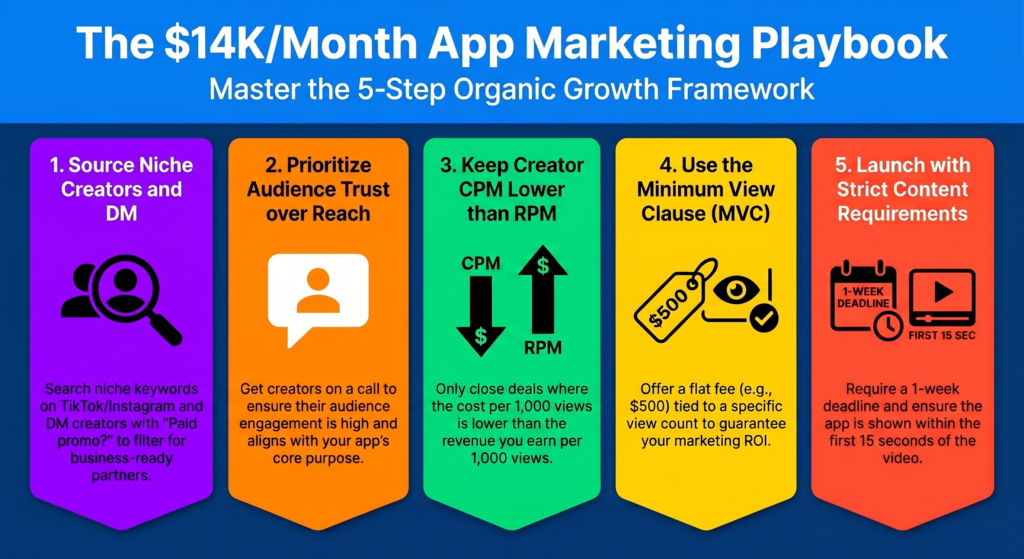
- Step 1: Search for creators in your specific niche on Instagram or TikTok.
- Step 2: Send them a direct message that starts exactly with “paid promo ?” to capture their attention and get them on a call.
- Step 3: Ensure the deal is profitable by keeping the creator’s Cost Per Mille (CPM) lower than the app’s Revenue Per Mille (RPM), which sits around $2 to $3.
- Step 4: Structure the deal. The founder uses four types of deals: a flat rate, a capped CPM deal, a bonus deal, or his favorite—a Minimum View Clause (MVC) deal. For example, he might pay a creator $500 but require that the video hits a minimum of 500,000 views.
- Step 5: Launch the partnership by sending a contract, a one-week deadline, and strict video requirements, such as making sure the app is shown within the first 15 seconds of the video.
Aftermarketing Strategy: If an influencer’s video hits the minimum view clause and generates strong revenue, the aftermarketing strategy is to re-engage them for an even bigger deal or pay them to post a few more videos to keep the momentum going.
Tech Stack Used to Build & Pricing Details of this Solo business
The app was built in about a month and a half using a very specific set of tools. Here is the tech stack and their pricing-
- Figma: Used to create the app’s initial designs from scratch.
- Xcode: Used to transfer the designs and build out the actual live application.
- Claude Code: An AI coding assistant used to help develop the app from start to finish. Pricing: $200 per month subscription.
- Superwall: A tool used to A/B test the app’s paywalls to see what converts best. Pricing: Takes 1% of the app’s total earnings.
- Supabase: Used to manage the app’s database. Pricing: Totally free.
Read more about Solo businesses.
Read more about Solo tools – Cut Coach, Micro-SaaS, Parakeet Chat

Hi Friends, This is Swapnil; I love reading and sharing knowledge. Currently working as a content writer at startupsunion.com. You all can hang out with me here.