What the Company Does (Explained simply for a 10th-grade understanding)
The app is called Cut Coach, and it is designed specifically to help combat sports athletes, like wrestlers and judo fighters, safely “cut weight.”
In combat sports, athletes must weigh a certain amount to compete in specific weight classes. Sometimes, an athlete needs to lose a few pounds very quickly right before a competition to qualify. Cut Coach acts like a smart digital assistant to help them do this safely by providing a science-based protocol.
Here is how it works:
- Tracking Food and Nutrition: The user logs what they eat (for example, a piece of chicken), and the app automatically figures out the exact nutritional value of that food and applies it to the athlete’s daily goal.
- Monitoring Progress: The user logs their weight every day so they can see their progress leading up to the competition.
- Recommending Meals: The app tells the user exactly what meals they should eat to stay within their strict nutritional limits, ensuring they don’t accidentally overeat and miss their required weight on competition day.
User Growth Framework and Marketing Strategy
The creator, Ethan, grew his user base through a step-by-step strategy focused on high-intent users:
- Organic Social Media Posts: He started by posting videos directly related to his niche. For example, he showed comparison videos of what UFC fighters looked like during a brutal weight cut versus what they looked like after recovering. He added a call-to-action at the end of the video encouraging people to download his app. Because the app solved such a specific problem, even videos with only 200 to 500 views converted into 10 to 15 downloads a day.
- Micro-Influencer Marketing: Next, he went on platforms like TikTok and Instagram Reels and scrolled his “For You” page to find small creators who were getting between 1,000 and 10,000 views per video. He sent them direct messages (DMs) asking to partner up. Because the product was so unique, most of these creators agreed. As the app grew, he started partnering with larger influencers getting 20,000+ views.
- Scaling with Paid Ads: As an aftermarketing strategy, once he saw which influencer videos were performing well, he repurposed those exact videos into paid advertisements. This allowed the app to scale much faster and brought in a lot of extra revenue.
Tech Stack Used to Build the App
Ethan used a highly efficient, AI-assisted tech stack to build the app quickly:
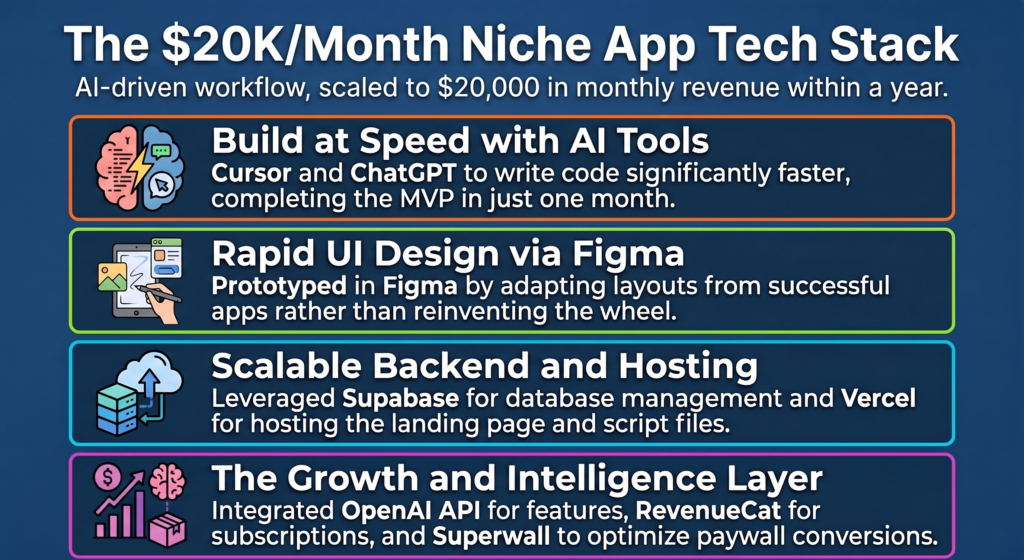
- Ideation & Design: ChatGPT for brainstorming ideas and Figma for designing the app’s layouts and wireframes.
- Coding: Cursor, an AI-powered code editor, paired with ChatGPT, to rapidly write both the front-end and back-end code.
- Database & Hosting: Supabase to store user data and Vercel to host the landing page and JavaScript files.
- AI Functionality: The OpenAI API to power the app’s internal AI features, such as extracting the nutritional values from the users’ food logs.
- Analytics & Monetization: RevenueCat and Superwall to manage the paywalls (how the app charges users), and Mixpanel to track app analytics.
- Automations: Cron jobs for handling scheduled automated tasks.
What is Ethan’s step-by-step process for building a niche app?
Step 1: Identify a problem within a personal hobby Ethan advises starting with a hobby you already understand and enjoy, as it makes it much easier to identify specific problems that others in that community most likely experience. To generate actual concepts, he recommends asking ChatGPT to brainstorm potential app ideas within your chosen niche.
Step 2: Design and adapt from successful competitors Once the core idea is finalized, Ethan immediately begins designing wireframes using Figma. Instead of starting entirely from scratch, he looks at the layouts of popular apps within similar niches and adapts their proven elements for his own app. This allows him to “stand on the shoulders of giants,” leveraging the extensive testing and resources those larger companies have already invested into user experience.
Step 3: Rapid AI-assisted coding For the actual development, Ethan uses the AI code editor Cursor to quickly build the front end of the app, making sure the generated code matches his Figma designs. After the front end is set, he uses a combination of Cursor and ChatGPT to write the back-end code.
Step 4: Integrate databases and essential services To complete the app’s functionality, he integrates a highly specific tech stack: Supabase for storing user data, Vercel for hosting the landing page and JavaScript files, and the OpenAI API to power the app’s core AI capabilities. He also implements RevenueCat and Superwall to manage subscriptions and paywalls, Mixpanel to track user analytics, and cron jobs to handle scheduled automated tasks.
Step 5: Beta test and iterate based on user friction After building his initial Minimum Viable Product (MVP) in about a month, Ethan gave it to his local wrestling club to beta test. He discovered a major flaw: the original app required coaches to distribute the weight-cut plans, which created too much friction and led to low usage. Because he prioritized user feedback, he spent the next two months completely redesigning the app so it would deliver plans directly to the athletes, tested the new weight cuts on himself, and successfully re-released it.
Step 6: Market, partner, and scale He launched his marketing efforts with organic social media posts featuring content highly relevant to his niche, such as videos of UFC fighters cutting weight, followed by a call-to-action to download his app. While view counts were low, the extreme niche focus meant the audience had high intent, leading to a strong conversion rate. To scale, he shifted to influencer marketing by directly messaging small creators (1,000 to 10,000 views) on TikTok and Instagram Reels. Finally, once he identified which influencer videos performed best, he repurposed those exact videos into paid advertisements, which drastically increased his revenue and scaled the app efficiently.
Read more about Solo businesses.
Read more Solo tools – Monai app, micro-SaaS, Parakeet Chat

Hi Friends, This is Swapnil; I love reading and sharing knowledge. Currently working as a content writer at startupsunion.com. You all can hang out with me here.