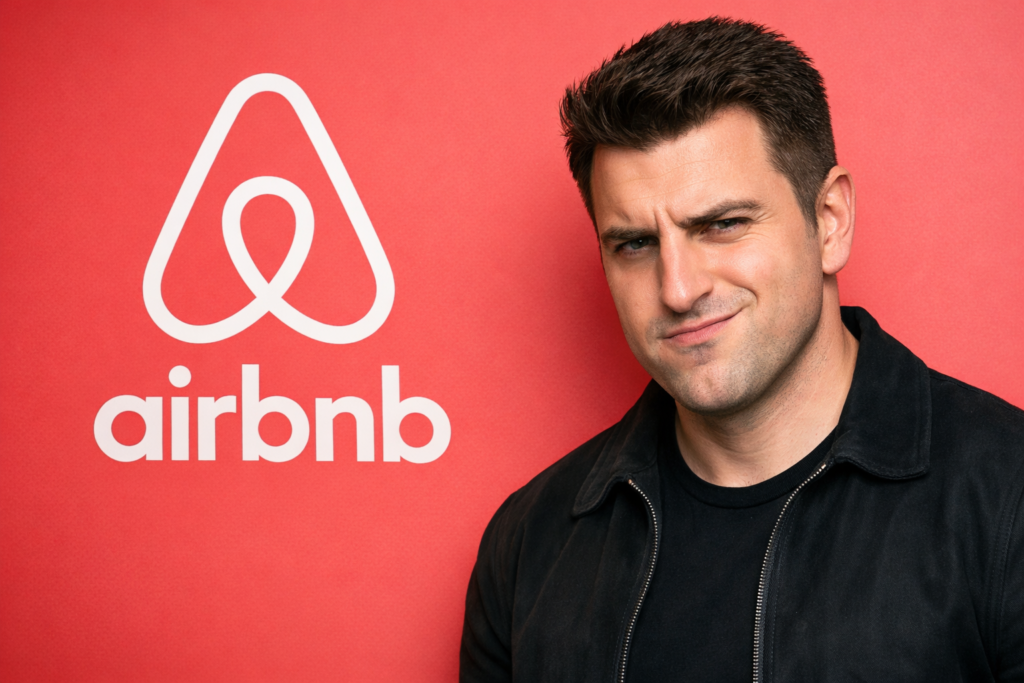
In October 2007, two unemployed art school graduates living in a three-bedroom apartment in San Francisco needed to make rent, so they decided to rent out air mattresses during a big design conference that overcrowded the city’s hotels. Founded by Brian Chesky, Joe Gebbia, and Nathan Blecharczyk in 2007, Airbnb has since become one of the most transformative companies in the travel and hospitality industry. Today, it operates as a global powerhouse, but its journey from a simple idea to a billion-dollar business reveals crucial lessons about problem-solving, design thinking, and relentless execution.
How It Started
The Problem
Airbnb addressed the high costs and limited availability of traditional accommodations, offering a more affordable and authentic alternative. When Brian Chesky and Joe Gebbia faced rent difficulties in San Francisco in 2007, hotels were fully booked during a local design conference, leading them to offer air mattresses in their apartment as a bed and breakfast. This wasn’t just a personal problem—it revealed a structural inefficiency in the travel industry that millions of people faced.
The Solution
AirBedandBreakfast.com was a marketplace for short-term stays focused on private homes, with an early model that took service fees from both guests and hosts. The first guests paid $80 each for this unique accommodation. Rather than waiting for investors or building complex infrastructure, the founders simply leveraged existing assets—spare space in their apartment—and created a direct connection between travelers and hosts through technology.
Target Audience
The first Airbnb guests included a 30-year-old Indian man, a 35-year-old woman from Boston, and a 45-year-old father of four from Utah. Initially targeting budget-conscious travelers seeking authentic experiences, Airbnb’s true market breakthrough came through focus and experimentation. With $20,000 in seed funding, the founders traveled to New York to find their target demographic and built strong relationships with customers.
Competitive Advantage
Airbnb’s success rested on several distinct competitive advantages:
- Design Excellence: From Day 1, Chesky and Gebbia built Airbnb to be a consumer-friendly marketplace, which not only won the company a legion of loyal fans but also helped it weather PR disasters.
- Professional Photography: They rented a $5,000 camera and went door to door, taking professional pictures of as many New York listings as possible. This solved a fundamental problem: users weren’t doing a great job of presenting their listings, and no one was booking because you couldn’t see what you were paying for.
- Two-Sided Marketplace Execution: Trust-building tactics included professional photography, a review system, and rigorous online payments to tackle the two-sided marketplace cold-start problem.
- Culture of Innovation: Airbnb’s culture served as the foundation for everything the company did, from hiring inquisitive people to building a culture of learning and experimentation.
How Airbnb Makes Money
Airbnb’s early model took service fees from guests and hosts. The company generates revenue primarily through commission-based transactions, collecting a percentage from both sides of the marketplace. When guests book a property, Airbnb takes a service fee (typically 10-16% of the booking value). Hosts also pay a service fee when their property is booked. Additionally, Airbnb collects processing fees for payment facilitation and has expanded into experiences and long-term stays, diversifying its revenue streams beyond traditional short-term rentals.
Market Share
Airbnb has surpassed industry legacy Hilton Hotels in nights booked. From a bedroom hack, Airbnb now lists over 7.7 million properties worldwide with 1.2 billion cumulative arrivals and $10.0 billion revenue in 2023, trading near a $90–110 billion market cap in 2024–2025. This extraordinary growth demonstrates Airbnb’s dominant position in the alternative accommodation space, though traditional hotel chains and other vacation rental platforms continue to compete in the broader travel market.
Business Model Canvas of Airbnb
Airbnb’s business model reflects its two-sided marketplace architecture. Key Partners include property hosts, payment processors, and technology platforms. Key Activities center on marketplace operations, trust-building through reviews, and listing optimization. Value Propositions include affordable accommodations, authentic experiences for guests, and income generation for hosts. Customer Segments span budget travelers, luxury seekers, and hosts from diverse backgrounds. Revenue Streams derive from service fees on both guest and host transactions, while Cost Structure involves technology infrastructure, customer support, marketing, and regulatory compliance. The model’s strength lies in its ability to scale supply and demand simultaneously while maintaining trust through systematic review mechanisms and professional presentation standards.
Conclusion
Airbnb represents a highly viable and proven business model that has fundamentally disrupted the global hospitality industry. The company has achieved billion-dollar valuations, massive scale, and sustainable profitability by solving a real problem through elegant design and relentless customer focus. While regulatory challenges and competition persist, Airbnb’s diversified revenue streams, global market dominance, and cultural resilience demonstrate its capacity for long-term viability. The platform continues to evolve, expanding into experiences, long-term rentals, and luxury properties. As a business, Airbnb has transcended its startup origins to become a multi-hundred-billion-dollar enterprise—a testament to the power of identifying genuine market inefficiencies and executing with design-centered innovation.

Hi Friends, This is Swapnil; I love reading and sharing knowledge. Currently working as a content writer at startupsunion.com. You all can hang out with me here.