What does OpenEvidence do (problem and solution)-
The medical system is suffocating under its own data. Every single year, 1.5 million new medical papers hit the presses. The total volume of medical literature literally doubles every five years. If a doctor actually wanted to stay current just by reading the top ten journals and new guidelines, they would need nine hours a day, every single day. It’s impossible. Without a reliable tool, doctors run the very real risk of missing critical new findings simply because they lack the time to track them down.
So, founders Daniel Nadler and Zachary Ziegler stepped in to fix this. In 2021, they launched OpenEvidence. The product is a medical search engine and chatbot built exclusively for doctors. Think of it as a clinical “brain extender”. A physician asks a highly complex medical question like figuring out the best antibiotic for a specific, complicated patient profile and the system fires back a fully cited, evidence-based answer in five to ten seconds.
But here is the kicker. The established competitors charge hospitals massive enterprise fees, usually around \$500 a seat. OpenEvidence bypassed that completely. They give their core product to verified doctors for free. They monetize the massive attention through an ad-supported model, charging pharma companies $70 to $150 CPMs to reach high-intent prescribers. It works. Over 40% of U.S. physicians now use it every day to make high-stakes decisions at the point of care.
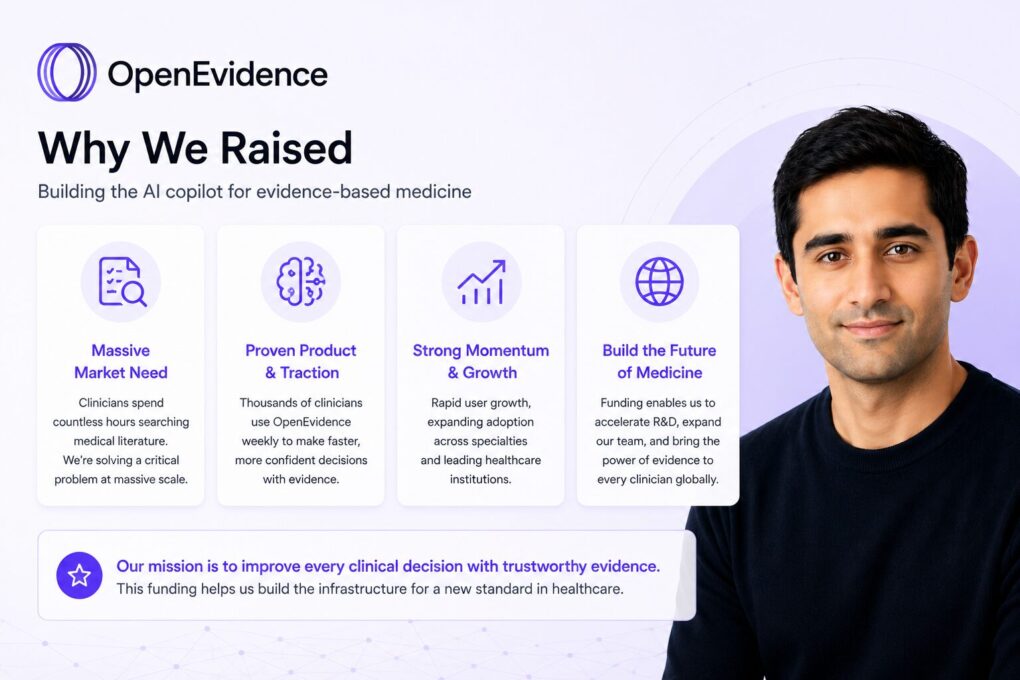
Why OpenEvidence raise $12 billion? Main reasons-
They have pulled in about \$735 million across 11 funding rounds. They did, however, just hit a massive $12 billion valuation after closing a $250 million Series D round in January 2026. Investors like Sequoia, Google Ventures, and Thrive Capital keep pouring money into them.
Why does a software company need hundreds of millions in venture capital? Because training true medical “superintelligence” is brutally expensive.
Compute costs are astronomical. They aren’t just calling a basic text model. They are training specialized systems capable of search, ranking, retrieval, and clinical-trial-matching. They even build proprietary models just to interpret the complex figures and tables buried inside scientific papers. You burn cash fast when you buy that kind of heavy processing power.
Then you have the talent and the data. OpenEvidence is using its war chest to pull top-tier scientists right out of PhD programs at Harvard and MIT. And you can’t train a reliable medical model on open internet junk. You need the absolute best data. They use the funding to secure exclusive, multi-year content partnerships with heavyweights like the American Medical Association, The New England Journal of Medicine, and the JAMA Network.
business Quiz

Vision and Future plans of OpenEvidence
You don’t build a $12 billion company just to be a standalone app on a doctor’s phone. To win, you have to be everywhere the actual work happens.
The reality is, their immediate future is all about deeply embedding into Electronic Health Record (EHR) systems. Through collaborations like their recent pilot with Sutter Health, OpenEvidence is actively integrating directly into Epic. This means doctors can pull evidence without ever breaking their charting workflow. That is exactly how they plan to eventually transition from ad revenue to selling enterprise per-seat pricing and data insights subscriptions.
And they are aggressively expanding what the tool actually does. In August 2025, they launched “Visits,” an ambient scribe tool that automatically drafts clinical notes from patient conversations. They are building AI agents to automate prior authorization letters, flag real-time drug interactions, and suggest order sets right at the bedside. Their goal is to completely consolidate functions currently spread across several different legacy tools.
Beyond the daily grind of the clinic, they are eyeing the massive drug discovery market. They partnered with Veeva Systems to launch “Open Vista” in 2026, a product suite built to match patients with clinical trials and speed up R&D.
Finally, they want more users. They are actively targeting the 5.2 million nurses, advanced practice providers, pharmacists, and medical students in the U.S. International expansion is next on the roadmap, starting with English-speaking markets like the UK, Canada, and Australia. They are moving fast. The only real threat left is if massive tech companies like OpenAI or entrenched giants like Epic decide to build the exact same thing.
Read about – Startup business models
Read in – Startup Directory
Read about Solo-businesses

Hi Friends, This is Swapnil; I love reading and sharing knowledge. Currently working as a content writer at startupsunion.com. You all can hang out with me here.