What the company does (explained simply for a 10th-grade level)
The company built an app called Floa, which is designed to help yoga teachers and people who practice yoga. Think of it as a smart, interactive digital notebook for creating custom yoga routines. Here is how it works in detail:
- Users can select a yoga style and swipe through a library of different poses.
- The app has an “intelligent feature” that acts like a smart assistant, suggesting which pose logically makes sense to do next.
- Users can filter poses based on categories, health benefits, or “chakras”, and they can watch detailed instructional videos to learn how to do each pose correctly.
- Once the poses are selected, users can completely customize their routine by setting exactly how much time to spend on each pose (and even adjust the time for the left or right side of the body). The app then guides them through their personalized practice.
The 0-1000 User Framework and After-Marketing Strategy
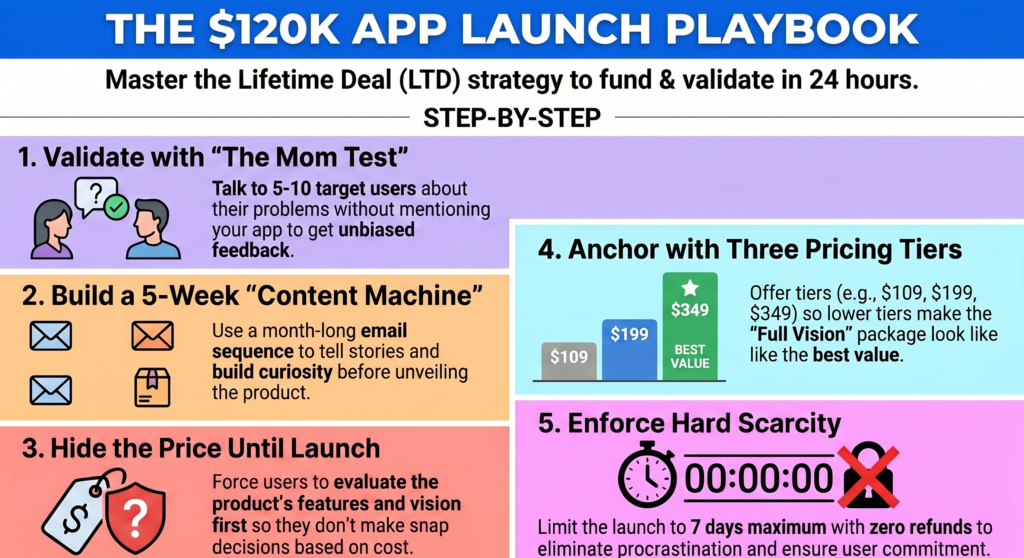
To get their first 500-600 users, the founder ignored the standard “free trial” model and instead launched with a limited-time “Lifetime Deal” (LTD).
- The Pre-Launch Framework: For about five weeks before launch, they warmed up an existing audience (gathered from a previous physical product business) and generated new leads. They did this by sending a sequence of storytelling emails and blog posts that slowly teased the app and built curiosity, all without ever revealing the price before launch day.
- The Launch: The launch was centered around a YouTube video where the founder walked through the app’s features. They used a psychological pricing strategy with three lifetime tiers ($109, $199, and $349) to make the higher tiers look more valuable. They set a strict deadline of 5 to 7 days and offered absolutely no refunds, which forced people to make a quick decision instead of procrastinating. This resulted in $120,000 in sales in just 24 hours.
- After-Marketing Strategy: After the lifetime deal ended, they transitioned the business to a recurring subscription model (monthly, quarterly, and yearly plans) which helped them scale to about 4,000 active users. To keep users engaged and improve the app, they created a Telegram group for their early adopters. Because these initial users had paid for lifetime access, they were highly committed and provided excellent feedback, bug reports, and feature suggestions that the company used to upgrade the app in the following months.
The Tech Stack Used
The app was built using the following technologies:
- Flutter: Used for the core app development.
- Firebase: Used for the backend. This is not totally free; it costs the company around $25 a month.
- RevenueCat: Used to handle user subscriptions.
- Vimeo: Used to host the app’s instructional videos. The founder noted they already had a paid Vimeo account from a previous business, so they just used that.
- OneSignal: Used to send push notifications to users.
Read more about Solo businesses.
Read more about Solo businesses – Locked, Cut Coach, Micro-SaaS, Parakeet Chat

Hi Friends, This is Swapnil; I love reading and sharing knowledge. Currently working as a content writer at startupsunion.com. You all can hang out with me here.