What the company does (Explained for a 10th-grade understanding)
The company is a minimalistic expense-tracking app called Monai. At its core, it solves the problem of people quitting their budgeting apps because they are usually too clunky or annoying to use. Instead of manually typing in every single purchase, Monai uses AI to make tracking your money completely frictionless.
A user can simply use their voice and say something like, “Coffee at Starbucks, 50 bucks,” and the app automatically logs the transaction, adds tags, and categorizes it. It also links directly with Apple Pay to automatically track purchases the moment you buy something. On top of tracking, the app acts like a personal financial advisor; you can ask it questions like, “I want to save €300 a month, where should I cut back?” and the AI will analyze your spending history to generate a custom savings plan. The app makes money by charging users a subscription after a 7-day free trial.
0-1000 User Framework & After-Marketing Strategy
For the first year and a half, the solo developer built the app but struggled with distribution, managing to reach only $300 in Monthly Recurring Revenue (MRR). To scale the app to over $35,000 MRR, the developer used a highly targeted “One Influencer” framework, ignoring the traditional advice of spamming hundreds of creators or running massive ad campaigns from day one.
- The Framework: The developer targeted a single, highly-aligned lifestyle and tech creator in an untapped market (Colombia) rather than the US. The outreach strategy involved warming up the relationship by actively following and commenting on the creator’s content, sending personalized outreach that referenced specific jokes or video moments, and proving that the app’s aesthetic perfectly matched the creator’s audience.
- The Deal: Crucially, the developer offered a profit-sharing partnership alongside a fixed monthly retainer. Because the influencer gets a cut of the profits, they have “skin in the game” and are financially incentivized to care about the app’s long-term growth.
- Marketing Strategy: The creator is responsible for all the creative ideas and posts exactly three high-quality, story-driven videos per month on his main channel. This “quality over quantity” approach ensures the audience isn’t spammed and converts at a very high rate.
- After-Marketing Platforms: Initially, all distribution happened organically through the influencer’s social media videos (which brought in up to 1.7 million views on a single post). Recently, as an after-marketing strategy to scale further, they began repurposing the creator’s best-performing videos to run paid Meta Ads. Because the video content was already proven to be highly engaging, these ads are currently showing great results to pour “gasoline on the fire”.
Tech Stack Used & Pricing Details
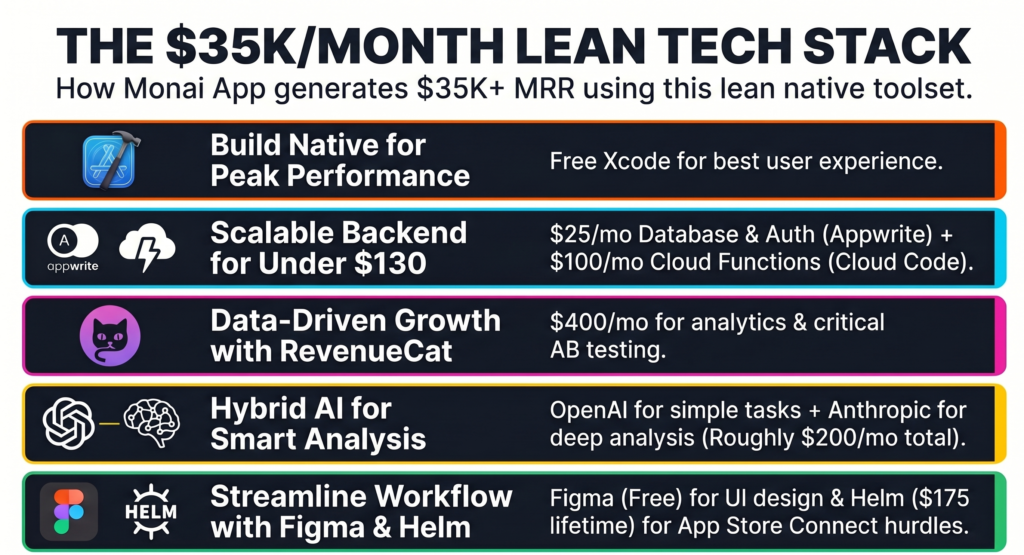
The developer built the app natively and keeps the infrastructure relatively straightforward. Here is the exact tech stack and the associated costs:
- Xcode: Used to build the native iOS app (Free).
- Figma: Used for designing the app (Free plan).
- Appite: Used for the backend, authentication, and database ($25 per month).
- Cloud Code: Used extensively for app infrastructure ($100 per month for the max plan).
- OpenAI & Anthropic: Power the AI features. OpenAI handles the easier tasks (like voice-to-text logging), while Anthropic handles the deeper financial analysis (~$200 per month combined).
- RevenueCat: Used to show revenue statistics and run A/B tests to optimize the paywall (~$400 per month).
- Helm: Used to bypass the usual headaches of Apple’s App Store Connect (~$175 one-time fee for a lifetime plan).
What is the five-step playbook for finding the right influencer?
Step 1: Find aligned partners Before reaching out, ensure that the influencer’s lifestyle, tone, and audience genuinely match your product. You should look for a creator with a great personality who actively connects with their viewers, such as frequently replying to comments, because their audience will inevitably have questions about your app. It is also beneficial to find someone who blends niches—like combining tech and lifestyle—so their audience is invested in the creator’s story, not just the technical specifications of a product.
Step 2: Warm up the relationship Take the time to follow the influencer and consistently comment on their videos before sending a pitch. Creators often notice recurring commenters, which proves you actually care about their content. If you do not have the time to do this, be upfront about it rather than faking that you have been following them for a long time.
Step 3: Be highly specific in your outreach Do not send generic messages like, “I love your content, let’s collaborate”. Instead, reference a specific video, a distinct moment, or a joke they made so they know you actually watch and appreciate their content.
Step 4: Connect the dots to your product Once you show appreciation for their work, demonstrate exactly how your product aligns with their brand rather than just treating it as a transaction. The creator shouldn’t feel like you are just paying them to make an ad; they should see a natural overlap. For example, if their audience clearly values aesthetics and nice tech, show them how your beautifully designed, tech-heavy app is a perfect fit.
Step 5: Acknowledge their value and signal willingness to pay early on This is considered the most important step. Set yourself apart from other pitches by leading with clear incentives. It works incredibly well to propose a long-term, profit-sharing partnership and to show them the actual earning potential of your niche. You can look up similar apps on platforms like Sensor Tower and tell the creator, “Other apps in this niche make $50k to $100k per month with the right distribution,” which gives them a concrete mental model of what the collaboration could achieve.

Hi Friends, This is Swapnil; I love reading and sharing knowledge. Currently working as a content writer at startupsunion.com. You all can hang out with me here.