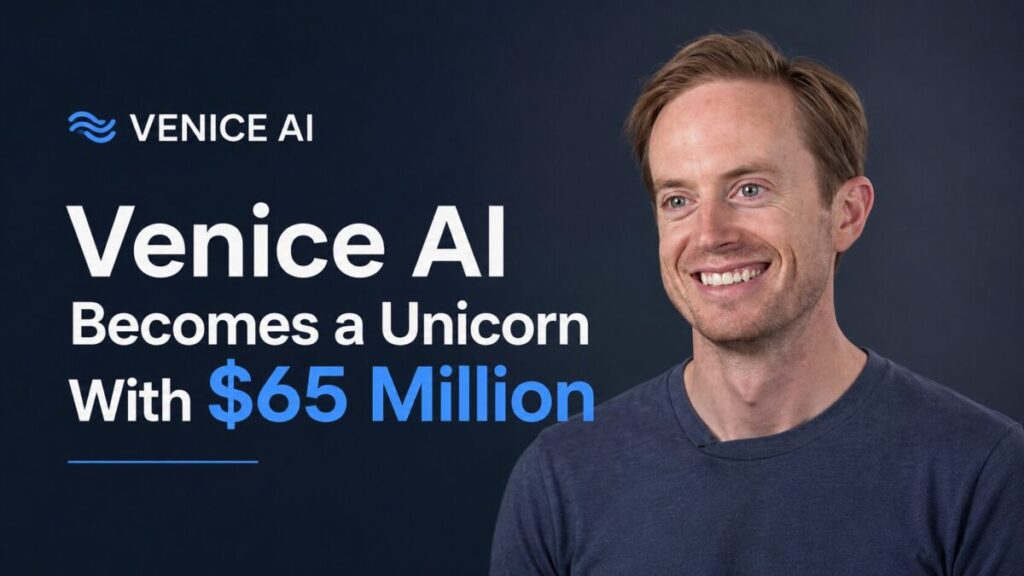
Most founders spend years chasing a billion-dollar valuation and never get there. Venice AI just did it on its first outside raise. The company closed $65 million in Series A funding, and that check alone pushed it to a $1 billion valuation. Two years old. First fundraise. Done.
Here’s the kicker. Venice AI didn’t need this money to survive. It wasn’t running out of runway or begging investors for a lifeline. It launched over two years ago with zero outside capital and just built. Quietly. Stubbornly. And the numbers eventually got too big to ignore. That’s a very different story than the one you usually hear in AI right now.
What Is Venice AI?
So what is Venice AI actually building? At its core, it’s a platform that gives people access to more than 200 leading AI models, covering text, image, video, and audio, all through one interface and one API. Venice AI didn’t try to outbuild OpenAI or Anthropic on foundation models. It took a different bet entirely: privacy first, restrictions minimal.
Some of the models run on Venice AI’s own infrastructure, the “uncensored” open-source ones. Other requests get routed out to closed-source models from the big labs. The founders knew exactly what they were doing here. Erik Voorhees, the CEO, has been in crypto since the early bitcoin days. He built Satoshi Dice. He built ShapeShift. Both of those were designed around one idea: don’t collect what you don’t need. Jesse Proudman, the president and CTO, brings a different kind of experience. He built and sold Blue Box to IBM. He built Strix Leviathan too. Two operators who’ve done this before, not first-timers figuring it out live.
Venice AI calls itself an AI safety company. Not in the way you’d expect. Their argument isn’t about controlling what the model says. It’s about controlling who gets to see what you asked it in the first place.
Venice AI Raises $65 Million Series A
The round closed on July 1. First external money the company has ever taken. And the structure of the deal tells you something too. It wasn’t a plain equity check. Investors got an 8.98% equity stake in Venice AI, plus a vesting grant of the company’s own VVV token, plus warrants to buy more VVV over the next eight years. Both the grant and the warrants stay locked for a year before they start vesting over the following three.
If those warrants eventually get exercised, the total raised could climb north of $131 million. That’s a meaningful detail. Most Series A rounds don’t come with token warrants attached. This one does, because Venice AI isn’t just an AI company. It’s a crypto-native company that happens to build AI products.
And here’s a choice that says a lot about how Voorhees thinks. He could have sold down Venice AI’s treasury of VVV tokens instead of giving up equity. He didn’t want to. He said so directly. Venice AI remains the largest holder of VVV out there, and he wasn’t going to touch it just to raise cash faster.
Who Invested in Venice AI’s Funding Round
Dragonfly led the round. If you know crypto venture, that name means something. They don’t typically write checks into consumer AI startups. They back blockchain infrastructure. So when Dragonfly leads a Series A for an AI product, that’s not random.
Coinbase Ventures joined too. So did North Island Ventures, F-Prime Capital, Archetype, Liquid2 Ventures, Morgan Creek, and Seattle’s own Founders’ Co-op. That’s a heavy crypto bench for a company that, on the surface, looks like an AI startup.
But it makes sense once you connect the dots. Voorhees spent his whole career building financial systems that don’t put your data in someone else’s vault. Venice AI is the same philosophy applied to AI chat instead of money. The investors backing it aren’t just betting on AI growth. They’re betting on the guy who’s been building privacy first infrastructure since before most people had heard the word “blockchain.”
Venice AI Hits $1 Billion Valuation
The reality is, most AI companies don’t get to a billion-dollar valuation this fast, and definitely not on a single round. It usually takes a seed, then a Series A, then a Series B, each one chasing the last valuation up a little further, hoping revenue eventually catches up to the number on the term sheet.
Venice AI flipped that order. The revenue showed up first. The valuation followed it. That’s rare enough in 2026 that it’s worth sitting with for a second.
So what happens with the money? Voorhees and Proudman have been clear. Build proprietary infrastructure. Expand into new markets. Look at acquisitions. Hire. But the big one, the one that shows up again and again when they talk about this raise, is getting off leased GPUs and onto owned infrastructure. That’s not a glamorous use of capital. It’s a margin play. And it’s the kind of decision a founder makes when they’re thinking five years out, not five months.
How Venice AI Protects User Privacy
Privacy isn’t a feature bolted onto Venice AI. It’s the whole reason the company exists. No logging of prompts. No storing your conversations on their servers. Your input gets encrypted client-side, decrypted only when it needs to be, and routed through an external proxy before anything gets processed. Practically speaking, your conversation stays tied to your device, not to some database sitting in a data center you’ll never see.
For certain models, Venice AI goes even further and offers end to end encryption as part of a paid tier.
Proudman’s argument here is simple, and it’s a good one. The danger isn’t necessarily what you type into a chatbot. It’s that all of that stuff piles up somewhere, forever, waiting for a breach, a subpoena, a disgruntled employee, or a policy change that suddenly makes your old medical question or legal question fair game. People are asking AI about health issues, legal trouble, job negotiations, and relationship problems. That’s intimate stuff. Most platforms keep it. Venice AI doesn’t.
It’s not all wide open, though. Fewer restrictions means more room for misuse, and Venice AI knows that. They’ve built in some safeguards against illegal activity. But the underlying bet stands: enough people want to be treated like adults, and they’ll pay for a platform that does that instead of assuming the worst about them.
Venice AI’s Revenue and User Growth
Numbers don’t lie, and Venice AI’s numbers are the reason this raise happened so fast. The company has crossed an annualized run rate revenue of over $70 million. And it turned profitable in the first quarter of 2026. In an industry where most companies are burning cash by design, that’s not normal.
The user side backs it up. Venice AI has pulled in more than 850,000 unique visitors to its website and serves more than 3 million active users, with some more recent numbers putting registered users closer to 3.5 million. The platform is processing roughly 1.3 trillion tokens a month, alongside an average of 1.7 million API calls a day. That’s not a side project anymore. That’s real usage at real scale.
What’s Next for Venice AI
So what’s next? Infrastructure, mostly. Venice AI wants to buy its own GPUs and stand up its first data center, moving off leased compute for good. That single move should push margins up and give the company more control heading into what they’re calling a coming resource squeeze in AI compute.
Beyond that, expect Venice AI to push into new markets, look seriously at acquisitions, and grow the team to support all of it. Proudman has said he wants Venice AI sitting on people’s phones right next to ChatGPT and Claude, not treated as some fringe alternative for the privacy-obsessed.
It’s a bold ambition. But the company has already done the hard part, building real revenue without outside help, before most people even knew the name. Whether privacy first AI becomes a real category or stays a smaller niche next to the giants, that’s the open question. For now, Venice AI’s $65 million round and $1 billion valuation say a lot of people are willing to bet on the answer being yes.
Sources used, compiled for the article:
- TechCrunch – Venice AI becomes a unicorn with $65M Series A as its privacy-first AI platform takes off
- GeekWire – Private AI: Venice.ai, led by crypto vet Erik Voorhees and Seattle’s Jesse Proudman, raises $65M
- Venice AI Official Blog – Venice Raises $65 Million Series A at a $1 Billion Valuation
- AI Weekly – Venice AI raises $65M at $1B, tops $70M ARR on privacy pitch
- SiliconANGLE – Venice raises $65M at $1B valuation for private, uncensored AI
Read about – Startup business models
Read in – Startup Directory
Read about Solo businesses

Hi Friends, This is Swapnil; I love reading and sharing knowledge. Currently working as a content writer at startupsunion.com. You all can hang out with me here.
Great article, thanks for sharing! For AI ads and avatar videos I recommend Pixwit: . Pixwit
¡Excelente artículo! Para convertir una línea de texto en una canción completa con IA prueba Happy Shrimp: /. Happy Shrimp
มีประโยชน์ Luna Lisa Alpha () text-to-image 1K/2K/4K Luna Lisa Alpha
Clear and useful tips here. One AI video tool I use is MiniMax H3 Video Generator: /. MiniMax H3 Video Generator