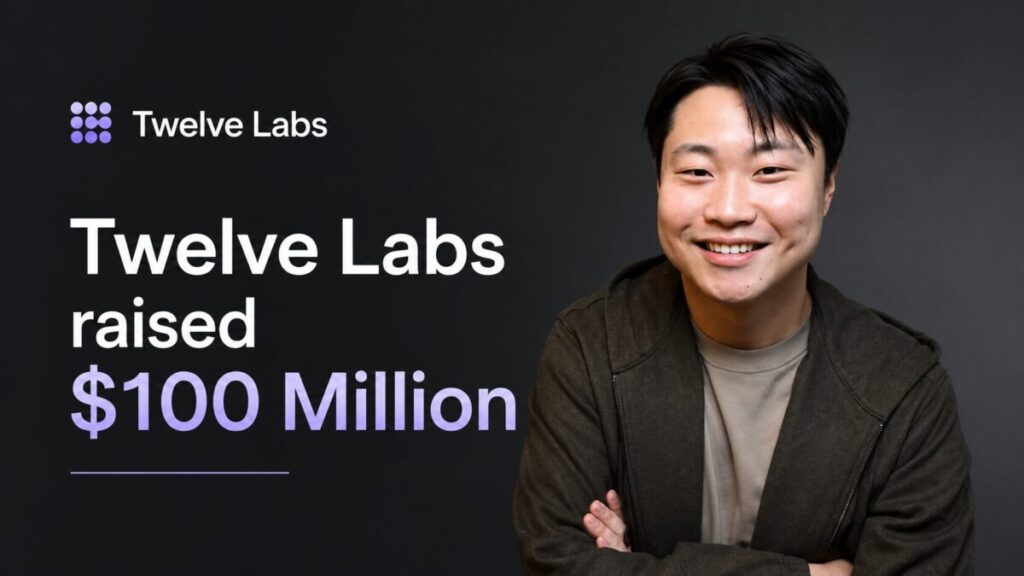
Twelve Labs just raised $100 million in Series B funding. Let that sink in for a second. This isn’t a seed round with a nice deck and a promise. This is real capital, from real investors, betting on the idea that video, not text, is where AI goes next.
The company is based in San Francisco. Jae Lee founded it back in 2021. Four years later, Twelve Labs has crossed $200 million in total funding. That’s not luck. That’s a founder who picked a hard, unfashionable problem and stuck with it long enough for the market to catch up.
Here’s the kicker. Two years ago, Twelve Labs closed a $50 million Series A, co-led by NEA and NVIDIA’s NVentures. That felt big at the time. Now it looks like a warm-up round. The Series B is double that size, and it’s meant to fund something bigger: a full system for how machines understand video, not just another point solution.
Jae Lee has said it plainly. Language is downstream of understanding. Video is the real substrate, the raw material of how humans actually experience the world, shape, motion, sound, sequence, all of it happening in real time. Most AI models were trained on the compressed version of reality, which is text. Twelve Labs bet on the uncompressed version. And that bet just got a lot more expensive to ignore.
Who Led the Twelve Labs Funding Round
So who actually wrote the checks? NEA and NAVER Ventures co-led the round. NAVER is the investment arm of the Korean internet giant Naver, and that connection matters more than people might assume.
The rest of the syndicate reads like a greatest hits list of Twelve Labs’ earlier backers. Amazon came back. Radical Ventures came back. Korea Investment Partners came back. Index Ventures came back too. And then two new names showed up on the cap table for the first time: Quadrille Capital and Red Bull Ventures.
The reality is, when your existing investors keep doubling down round after round, that tells you something. It’s not just capital, it’s conviction. NEA has now backed Twelve Labs across both the Series A and Series B. That’s not a passive bet. That’s a firm that believes it found a platform company, not a one-hit product.
And the Korean investor base isn’t incidental. Twelve Labs runs offices in both San Francisco and Seoul. Building across two continents from day one is brutal. It’s lonely. It’s hard. But it clearly worked, because the Seoul relationships are still showing up on the term sheet years later.
Amazon’s Strategic Investment in Twelve Labs
Let’s be honest, most “strategic investments” are just marketing dressed up as a partnership announcement. This one isn’t. Amazon didn’t just put money in. It restructured how Twelve Labs runs its business.
Twelve Labs named AWS its top-priority cloud provider. Under a multi-year deal, the company will run its video inference workloads on Trainium, AWS’s own AI chip. New models from Twelve Labs will now launch on AWS first, before anywhere else. That’s a real commitment, not a press release line.
There’s already distribution in place too. Twelve Labs’ models run through Amazon Bedrock and through the company’s own API. So enterprise customers already living inside AWS can plug in Twelve Labs without touching a separate vendor relationship. That’s the kind of friction removal that actually moves adoption numbers, not just headlines.
Jason Bennett, who leads AWS’s startup and venture capital group, publicly credited Twelve Labs with pushing the boundaries of what AI can perceive from video. Coming from AWS, that’s not just flattery. It’s Amazon signaling where it wants enterprise video workloads to live going forward. And that’s Twelve Labs’ cloud.
What Is Twelve Labs’ Video Cognition System
Here’s where it gets technical, but stay with me, because this is the actual product, not just the funding story.
Twelve Labs calls it the Video Cognition System. Three pieces make it work: perception, memory, and reasoning.
Perception comes from Marengo, the company’s embedding model. It takes visual, audio, speech, and on-screen text and maps all of it into one searchable representation. Reasoning comes from Pegasus, the video-language model, which turns those embeddings into actual answers, summaries, and descriptions a human can use.
But memory is the piece that makes this different. Most AI systems today look at a video, answer a question, and forget everything. Ask again tomorrow, and the system starts from zero. Twelve Labs built the opposite. A video gets understood once. It’s converted into a durable structure and kept addressable down to the exact second of the exact file. So the archive stops being dead storage. It becomes something the machine can actually reason with, over and over, without reprocessing the raw footage every single time.
That compounding effect is the whole bet. The more video the system touches, the smarter it gets. Not in a vague, marketing sense. Structurally.
Twelve Labs Total Funding Crosses $200 Million
Do the math and it adds up fast. A modest early round, then $50 million in the Series A, and now $100 million more in the Series B. Total funding has now passed $200 million.
That’s a serious amount of capital for a company operating in a narrow, technically demanding niche like video AI. It’s not a horizontal chatbot play chasing every possible use case. It’s a deep, infrastructure-heavy bet on one modality. And investors have shown up for it twice now, with almost the entire original backer list returning for round two.
No valuation was disclosed alongside this raise. But when nearly every prior investor comes back and new names like Quadrille Capital and Red Bull Ventures join in, that usually isn’t a coincidence. It’s a signal that the company’s technical progress since the Series A actually matched, or beat, what investors were promised.
Twelve Labs and AWS Partnership Explained
Worth breaking this down further, because it’s easy to gloss over as just another cloud deal. It isn’t.
The multi-year Trainium agreement means Twelve Labs gets access to infrastructure that’s purpose-built for AI inference at scale, not general-purpose compute retrofitted for the job. That matters a lot when your core product is processing enormous volumes of video.
The Bedrock distribution piece matters just as much. Enterprises already running on AWS can bring Twelve Labs into their stack without a separate procurement headache. No new vendor onboarding. No separate infrastructure to manage. It just sits inside what they already use.
And going forward, new Twelve Labs models debut on AWS before they show up anywhere else. That’s a meaningful commitment. It ties Twelve Labs’ product roadmap directly to Amazon’s cloud strategy, which cuts both ways, but for now it’s clearly working in Twelve Labs’ favor.
What This Means for the Future of Video AI
So where does this leave things? Video is the category everyone suspected was coming next, but almost nobody had built real infrastructure for yet. Twelve Labs just got a huge vote of confidence that it’s the company doing that work seriously.
Beyond the core models, Twelve Labs recently launched a closed beta of Rodeo, an AI-powered video creation tool. That’s a notable shift. It’s not just serving developers and enterprises anymore. It’s reaching toward everyday users creating content directly. The company is also expanding physically, reinforcing San Francisco and Seoul while opening new offices in New York, London, and Los Angeles.
The use cases stack up quickly once you think about it: security footage, advertising archives, sports analytics, automotive testing. All of it sitting there, mostly unused, because machines couldn’t really understand video the way they understand text. That’s the gap Twelve Labs is trying to close.
The reality is, most of the world’s information was never written down. It happened. It was recorded. And until now, machines couldn’t really make sense of it. Whether Twelve Labs becomes the default layer for that shift or just one strong contender among many, this raise makes one thing clear. Video AI just stopped being a side bet and started looking like the next real frontier.
Sources used for this article:
Read about – Startup business models
Read in – Startup Directory
Read about Solo businesses

Hi Friends, This is Swapnil; I love reading and sharing knowledge. Currently working as a content writer at startupsunion.com. You all can hang out with me here.