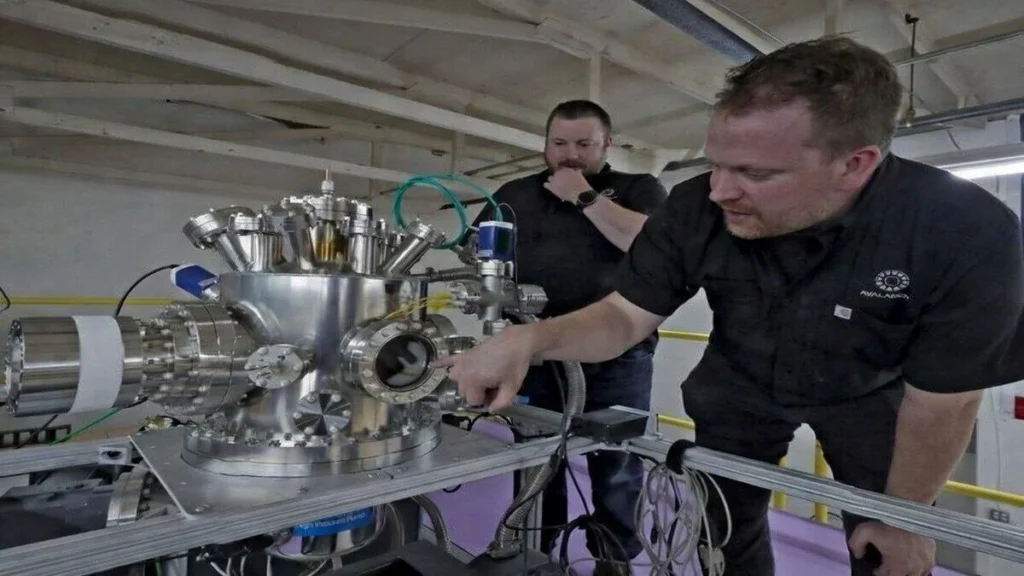
How Avalanche Energy Started
June 2021. Robin Langtry and Brian Riordan—both former Blue Origin engineers—looked at the fusion industry and saw something everyone else missed: it was going the wrong direction.
The conventional wisdom? Build massive, billion-dollar reactors. Spend decades perfecting them. Eventually, they’ll generate net energy. Langtry and Riordan said, “That’s insane. Let’s go smaller.”
They started Avalanche Energy with a radical idea: build a desktop-sized avalanche fusion reactor. Something small enough to fit in a lab. Something you could actually test and iterate on in months instead of decades. Something using electrostatic ion traps operated at hundreds of kilovolts—the exact opposite of the massive magnetic confinement reactors everyone else was chasing.
By 2022, they’d raised their first $40 million Series A from Lowercarbon Capital, Founders Fund, and Toyota Ventures. By 2023, they’d hit 200 kilovolts—a record nobody else had achieved. By July 2025, they’d sustained 300,000 volts in their laboratory. By February 2026, they’d raised $29 million more (bringing the total to $69M) and are eyeing a Series B targeting $100 million.
But here’s the real story: this tiny Seattle startup just became the most dangerous threat to traditional fusion’s slow approach.
The Problem, Solution & Target Audience
The Problem: The world needs clean energy desperately. Solar and wind are great but intermittent. Batteries are getting better but still limited. Nuclear fission works but leaves waste. Fusion is the holy grail—basically unlimited clean power from seawater—but it’s been “30 years away” for 70 years.
Why? Because traditional fusion startups are building the avalanche fusion reactor equivalent of the space shuttle when they should be building rockets. Billions of dollars. Decades of R&D. And still no commercialization.
Meanwhile, data centers are consuming absurd amounts of power. Satellites need compact power sources. Underwater drones need independent energy. Remote bases need decentralized power. The demand for small, distributed, clean power is absolutely real—but nobody’s supplying it because everyone’s chasing the mythical grid-scale avalanche energy solution.
The Solution: Avalanche Energy built a desktop-sized avalanche reactor using electrostatic ion traps. No massive magnets. No billion-dollar facilities. Just intense electrical currents creating 300,000-volt electric fields that push ions into tight orbits. As density increases, ions collide and fuse, releasing energy. The breakthrough? They proved it actually works at commercial voltage density (6 million volts per meter). That unlocks neutron generation—which has immediate commercial value.
Target Audience:
- Data center operators needing distributed, carbon-free power
- Space agencies needing compact satellite power
- Military applications requiring autonomous power generation
- Semiconductor manufacturers (using fusion neutrons for materials doping)
- Medical isotope producers (neutrons create radioisotopes)
- Any industry with austere power needs in grid-challenged locations
Competitive Advantage MOAT (Unique Strengths)
• Desktop-Sized Avalanche Fusion Reactor Design: Only 9 centimeters in diameter currently, scaling to 25 centimeters. While competitors are building massive rooms full of equipment, Avalanche’s avalanche energy reactor fits on a lab bench. That means rapid iteration. Test-fail-fix cycles in weeks, not years.
• 300,000-Volt Breakthrough Nobody Else Has: Achieved July 2025. Sustained for hours. This voltage density unlocks commercial neutron generation—something other fusion startups can’t do. That’s immediate revenue from neutron applications while waiting for power generation.
• FusionWERX Commercial Testing Facility: $10 million Washington State grant (July 2025) to build the world’s first commercial-scale fusion testing facility in Richland, Washington. This becomes their moat. Competitors need to book time at Avalanche’s facility to test their own technology. Avalanche gets access to their data AND rental fees.
• Orbitron Technology Advantage: Electrostatic ion trap design is fundamentally different—and simpler—than magnetic confinement. Fewer moving parts. Lower operating complexity. Better scalability. The Avalanche fusion reactor design is elegant where competitors’ are brute-force.
• First-Mover in Commercial Neutron Generation: Already signed first neutron customer for semiconductor doping. Revenue starting 2028. While other fusion companies are still in R&D hell, Avalanche Energy is monetizing interim products.
How Avalanche Energy Makes Money
Avalanche operates a three-revenue-stream model:
Neutron Sales: Generate neutrons using the avalanche reactor and sell them to semiconductor companies for advanced doping, medical isotope producers for radioisotope creation, and research institutions. Predicted to generate $30-50M annually by 2029.
FusionWERX Facility Rentals: Other fusion startups, universities, and national labs book time to test their fusion technologies. Avalanche charges for facility access. Margins are incredible—they just have to run the facility, then collect rental fees.
Future Avalanche Energy Fusion Power: Long-term, when the avalanche fusion reactor achieves Q>1 (more power out than in), they’ll generate electricity. That’s the endgame. But near-term, neutrons and facility rentals carry them.
The unit economics are wild: neutrons have zero marginal cost after you’ve built the avalanche reactor. FusionWERX facility operations scale beautifully—more customers don’t significantly increase costs.
Market Share of Avalanche Energy
Avalanche is brand new (founded in 2021, just at the Series A+ stage), so traditional market share is minimal. But here’s why investors are going nuts:
• Neutron Market: Medical isotopes and semiconductor doping represent a multi-billion-dollar industry. The avalanche fusion reactor is the only compact commercial source. They could capture 20-30% of this market alone, which is a $500M-$1B revenue opportunity.
• Fusion Power Market: If grid-scale power generation happens, the global energy market is $2+ trillion. Even 1% = $20+ billion addressable.
• Data Center Power: Google, Amazon, and Microsoft are desperately seeking distributed, carbon-free power. If Avalanche’s future megawatt-scale avalanche reactor works, this market is $50B+.
• Space & Defense: The compact avalanche energy reactor is perfect for satellites, submarines, and remote military bases. U.S. government is increasingly interested. That’s a multi-billion dollar TAM.
• Strategic Position: Avalanche Energy is the only company with a working commercial avalanche fusion reactor generating neutrons. Competitors (Commonwealth Fusion, Helion, and TAE) are years behind. That first-mover position in the neutron market is defensible.
Conclusion-
Avalanche Energy didn’t follow the fusion playbook. Everyone said, “Go bigger.” Avalanche said, “Go smaller, smarter, faster.” And it’s working.
While other fusion startups are still burning through billions on massive reactors, Avalanche’s avalanche fusion reactor is already generating revenue from neutrons. The avalanche energy company is turning profit pathways on while building toward grid power.
That’s not just a different approach. That’s an entirely different category. The avalanche reactor isn’t competing with massive fusion reactors—it’s creating a market nobody knew existed.
When you’re the only one with a technology that actually works commercially? That’s a moat. That’s market dominance. That’s why Avalanche Energy is the future of fusion.
Read More- Business Model of Waymo

Hi Friends, This is Swapnil, I am a content writer at startupsunion.com