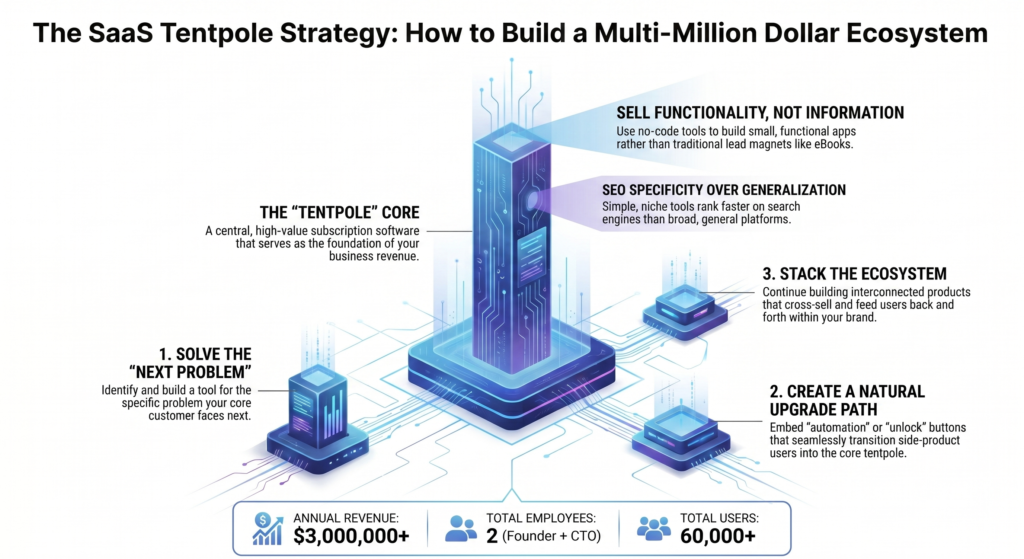
Taskmagic’s marketing and sales approach centers on a unique framework called the Tentpole Strategy, which shifts away from traditional SaaS marketing of a single product to building an interconnected ecosystem of “side products.”
The following components define this strategy:
The Tentpole Framework
Instead of focusing all marketing efforts on the core product (the “tentpole”), the company builds small, specific side products that solve immediate customer problems and funnel users into the main software.
- The Core Product: Taskmagic, a browser-based automation tool.
- Side Products: Tools like Mail Lead (an email outbound platform) and Lead Quest (an AI lead search tool).
Marketing through SEO Specificity
The company uses these side products to dominate search results. Because SEO favors specificity, a niche tool like “cold outreach email for a specific sector” ranks much faster and higher than a general term like “automation.” These specific tools attract new customers who may not have been looking for Taskmagic initially but find it through the side product’s SEO lift.
Sales and Natural Upgrade Paths
The sales process is built on a “natural upgrade path” where the side products act as a lead magnet for the core business.
- Seamless Integration: Within side products like Mail Lead, there is an “automation” button that connects directly to Taskmagic.
- Upsell Opportunities: When users hit limits or want to connect their side tool to other apps, they are funneled into a Taskmagic subscription.
- Cross-Selling: The products are designed to serve the same ecosystem, allowing for constant cross-selling between Lead Quest, Mail Lead, and Taskmagic.
Pricing Strategy
To “bankroll” the business early on and appeal to users who dislike recurring monthly costs, the company utilized the following:
- Lifetime Deals: Offering one-time payment options.
- Usage-Based Pricing: Charging based on how much the customer actually uses the software.
By treating products almost like “content” that can be created quickly, the company was able to scale to $3 million in annual revenue with only one founder and one employee.
How did lifetime deals help bankroll the company early on?
Lifetime deals were a crucial “unlock” for Taskmagic in its early stages because they catered to customers who were reluctant to commit to recurring subscription pricing.
By offering a one-time payment option instead of a constant monthly fee, the company was able to generate the immediate capital necessary to bankroll itself at the beginning. This strategy, combined with usage-based pricing, allowed the business to fund its operations and growth without relying solely on traditional subscription models.
Why did SEO specificity matter for their side product strategy?
SEO specificity was a critical component of the tentpole strategy because it allowed the company to bypass the difficulty of ranking for broad, competitive search terms. According to the sources, SEO is naturally boosted by specificity, meaning a niche tool can rank higher and faster than a general one.
Here is why specificity mattered for their side product strategy:
- Faster Ranking: While a general term like “automation” (which describes the core product, Taskmagic) is hard to rank for, a specific term like “cold outreach email for some sector” can reach the top of search results much more quickly.
- Targeted Customer Acquisition: By building simple, highly specific side products like Mail Lead (an outbound tool), the company attracted users who were searching for a solution to a very narrow, immediate problem.
- Independent “SEO Lift”: These side products were designed to rank on their own, effectively acting as independent lead generators that brought in new customers who may not have been searching for Taskmagic initially.
- Funneling to the Core: Once users found these specific side products through SEO, the company used a natural upgrade path to funnel them into the main Taskmagic ecosystem.
By focusing on specific functionality rather than general information, the company used these side products to create an SEO-driven ecosystem that eventually helped scale the business to $3 million in annual revenue.
/

Hi Friends, This is Swapnil; I love reading and sharing knowledge. Currently working as a content writer at startupsunion.com. You all can hang out with me here.