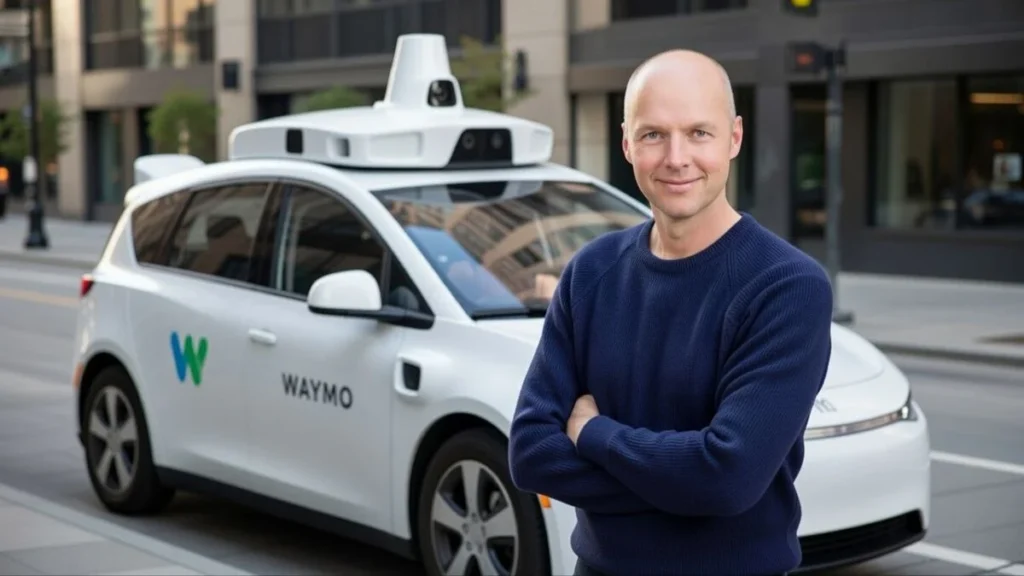
How Waymo Started?
January 2009. Sebastian Thrun and Anthony Levandowski launched Google’s self-driving car project from Google X (Alphabet’s moonshot factory). The mission was dead simple: prove that cars could drive themselves safely without human intervention.
But here’s the real story—this wasn’t random. Levandowski had already built the first self-driving Prius on a budget in 2008, demonstrating autonomous vehicles were physically possible. Google founders Sergey Brin and Larry Page saw the proof and said, “Let’s build this properly.” They challenged the team to drive autonomously over ten uninterrupted 100-mile routes without disengagements. By December 2009, the team had completed their first route.
They started with modified Toyota Prius vehicles, added a Lexus RX450h in 2012, and by October 2015 unveiled the “Firefly”, a self-driving car prototype with no steering wheel or pedals. By December 2016, the project spun out of Google and became Waymo, an independent Alphabet subsidiary.
Fast forward to October 2020: Waymo became the first company to offer commercial ride-hailing service without safety drivers. Today, they operate across Phoenix, San Francisco, and Los Angeles with over 20 million miles of real-world autonomous driving experience.
The Problem, Solution & Target Audience-
The Problem: Every year, 1.35 million people globally die in traffic crashes. In the U.S. alone, that’s 35,000+ deaths annually. The brutal truth? 94% of crashes involve human error. People get distracted. They get tired. They get drunk. They make split-second mistakes that cost lives.
Additionally, elderly people, blind individuals, and disabled populations can’t drive traditional vehicles. They’re trapped, dependent on others, unable to move around independently. The transportation system is literally broken for them.
The Solution: The Waymo self-driving car uses computer vision, lidar, radar, and artificial intelligence to perceive the world in 360 degrees—something human drivers never get. The self-driving taxi operates continuously, never gets tired, and never gets distracted. The Waymo car removes human error entirely.
The robotaxi operates as a fully autonomous ride-hailing service. Customers download the Waymo app, hail a ride, and a Waymo self-driving vehicle arrives without a human driver in the front seat. It’s ride-hailing, but better—no driver to wait for, no tips to calculate, completely autonomous operation.
Target Audience:
- Urban commuters who want to avoid traffic and stress
- Elderly and disabled populations who can’t drive
- People in the Waymo service area (Phoenix metro, San Francisco Bay Area, Los Angeles)
- Professionals and students wanting to reclaim time during commutes
- Anyone who values safety over the traditional driving experience
Competitive Advantage MOAT (Unique Strengths)-
• 20+ Million Miles of Real-World Autonomous Driving Data: Waymo has driven more autonomous miles than every competitor combined. That data feeds AI models, making the Waymo self-driving system smarter. Every trip teaches the system. Competitors are years behind.
• First to Market with Commercial Driverless Service: Waymo One (the robotaxi service) launched in October 2020 without safety drivers. Tesla’s full self-driving remains supervised. Cruise shut down its driverless program. Waymo is the only one actually running paid, fully autonomous robotaxis at scale.
• Strategic Fleet Partnerships: Waymo Jaguar Land Rover partnership (ordered 20,000 I-Pace electric SUVs). Chrysler Pacifica Hybrid integration for ride-hailing. These exclusive partnerships lock in vehicle supply and integration advantages competitors can’t replicate.
• Proven Business Model at Scale: 450,000 paid robotaxi trips per week. $350M+ annual recurring revenue. This isn’t beta testing—this is commercial traction. Waymo’s self-driving technology is actually making money, something no competitor has achieved.
• Best-in-Class Sensor & Hardware: Waymo’s custom lidar system costs 90% less than 2009-era Velodyne systems. Proprietary sensors, chips, and hardware designed specifically for autonomous driving. Competitors rely on off-the-shelf components.
How does Waymo make money?
Waymo operates a simple, scalable revenue model:
Robotaxi Ride-Hailing: Users book rides via the Waymo app. Waymo charges per mile/minute, similar to Uber/Lyft, but with a fully autonomous self-driving vehicle instead of a human driver. The Waymo car price to consumers is competitive with traditional taxis. Higher margin because there’s no driver to pay.
Waymo Service Area Expansion: Each new city (Phoenix, San Francisco, Los Angeles) is a new revenue stream. Rolling out Waymo One across the U.S. and eventually globally scales the business exponentially.
Waymo Price Model: More affordable than human-driven options in many cases. The unit economics improve as the fleet scales—more rides per vehicle = higher utilization = better margins.
Data Monetization: Anonymized driving data from 20+ million miles is valuable to automotive companies, insurance firms, and urban planners. Waymo could license insights without sharing proprietary autonomous systems.
Market Share of Waymo-
Here’s where it gets absolutely insane:
• Robotaxi Market: Waymo effectively owns 100% of the commercial driverless ride-hailing market right now. Tesla offers supervised “full self-driving”—not driverless. Cruise shut down. No competitor operates paid, fully autonomous robotaxis at Waymo’s scale.
• Growing Addressable Market: Urban ride-hailing is a $100+ billion global market. If Waymo captures even 10% with robotaxis, that’s a $10B+ revenue opportunity. The Waymo car has 20+ million miles, proving reliability.
• First-Mover Advantage Locking In: Early users in the Waymo service area (Phoenix metro 315 square miles, full San Francisco 7×7 grid, Los Angeles coverage) become sticky customers. Network effects kick in—more Waymo cars mean shorter wait times, which drives adoption.
• Geographic Dominance Building: Three major U.S. markets under belt. The next expansion targets Seattle, Austin, and other major metros. By 2027, Waymo could operate in 15+ cities, making the Waymo self-driving taxi the de facto transportation standard in urban America.
• Valuation Signal: The January 2026 fundraise at a $110 billion valuation signals investors believe Waymo will dominate mobility. That’s higher than Ford’s market cap ($30B) and comparable to Toyota ($250B). The market believes in Waymo’s dominance potential.
Summary-
BEFORE: 1.35 million people died annually in traffic. Cars needed humans behind the wheel. Autonomous vehicles? Pure science fiction. Nobody believed it was actually possible.
THE BRIDGE: Waymo spent 17 years obsessively building proof. 20+ million autonomous miles. October 2020—they launched the first fully driverless robotaxi without safety drivers. Zero humans in the front seat. Real people. Real money. Real trips.
AFTER: Today, 450,000 paid robotaxi trips per week. $350M+ annual revenue. Zero fatal accidents in commercial service. Cities are redesigning around Waymo infrastructure. The impossible became ordinary.
Read More- Business Model of ASML

Hi Friends, This is Swapnil; I love reading and sharing knowledge. Currently working as a content writer at startupsunion.com. You all can hang out with me here.